Spare Parts Inventory Template
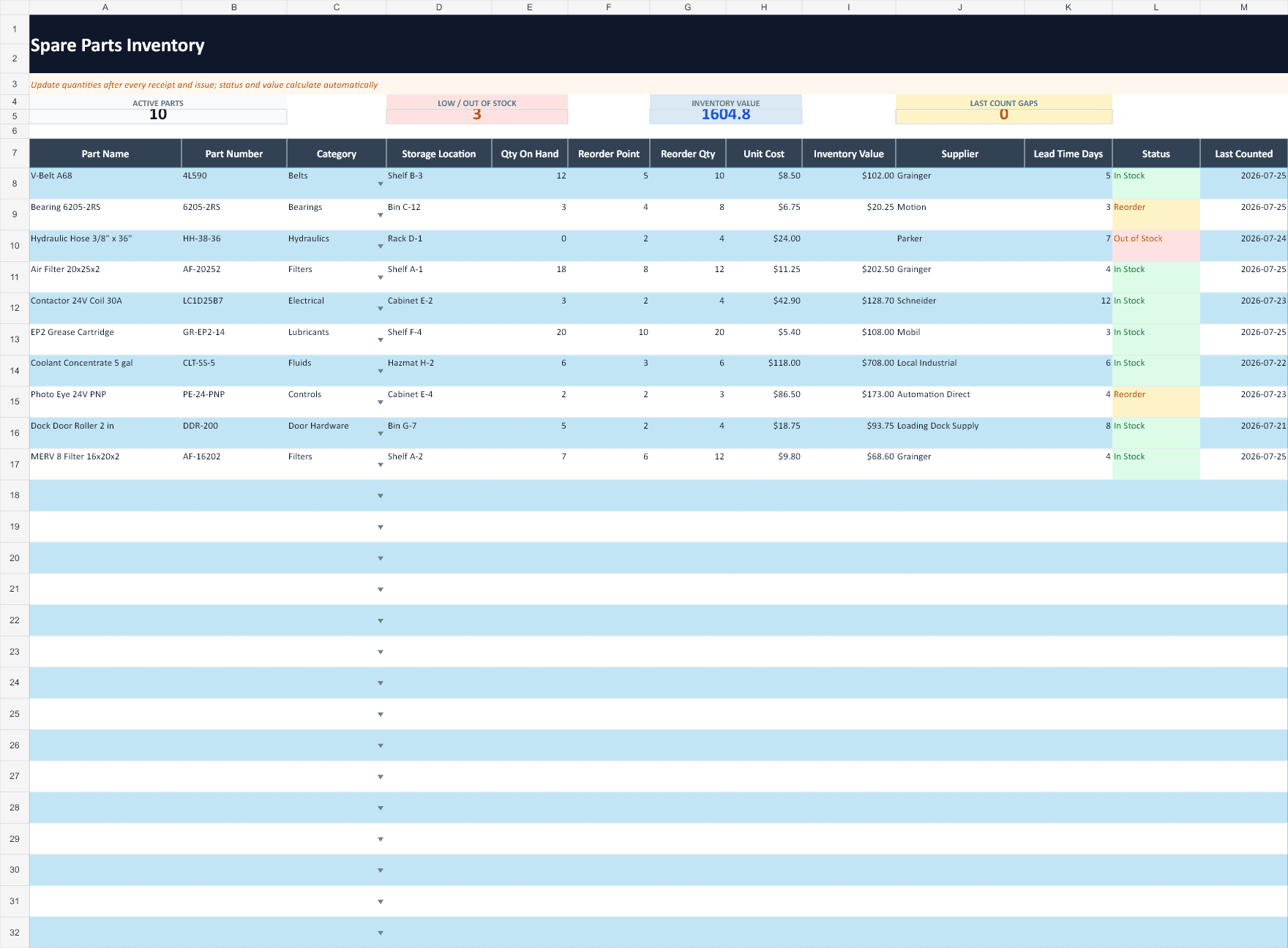
A ready-to-use parts inventory for Excel or Google Sheets — quantities, reorder points, locations, costs, and suppliers in one clean list. Free, no signup. A separate RunTight Import sheet uses the exact import columns, so if you outgrow the spreadsheet you can save that sheet as CSV and import your parts without retyping them.
What to track — and why these columns
Quantity on hand, reorder point, and location are the trio that prevents stockouts. Quantity tells you what you actually have, the reorder point tells you when to buy more, and the location means someone can find the part at 2 a.m. instead of ordering a duplicate. Part number, unit cost, and supplier round it out so reordering is a two-minute job instead of a research project. For the bigger picture — what to stock, how much, and how to keep the list honest — see our guide to maintenance parts inventory management.
How to set reorder points
The formula is: reorder point = lead-time demand + safety stock. If you use two V-belts a week and your supplier takes three weeks to deliver, lead-time demand is six. Add a safety buffer — say two more — to cover usage spikes or a late shipment, and your reorder point is eight. Don't agonize over precision on day one; a rough number beats no number, and you'll tune it as you see real usage. Our reorder point calculator does the math for you.
Doing your first physical count without boiling the ocean
You don't need to count every washer in the building. Start with the parts that stop production when they're missing — belts, bearings, motors, critical filters — and get those rows accurate first. That's usually a few dozen items, not a few thousand. Add the long tail over time as parts come through the door. A 90%-accurate list of critical spares beats a stalled project to catalog everything.
Frequently asked questions
What should a spare parts inventory include?
At minimum: the part name, part number, category, storage location, quantity on hand, reorder point, unit cost, and supplier. Quantity, reorder point, and location are the three that prevent stockouts — the rest make purchasing and cost tracking easier. This template includes all eight columns.
How do you set a reorder point?
Reorder point = lead-time demand + safety stock. Estimate how many of the part you use during the supplier's lead time (e.g., 2 per week × 3-week lead time = 6), then add a safety buffer for demand spikes or late deliveries. When quantity on hand drops to that number, reorder.
How do you organize a small parts room?
Give every part a labeled home — shelf, bin, or cabinet with an ID like B-3 — and record that location in your inventory list. Group by category (belts, bearings, filters, electrical), keep fast-movers near the door, and make one rule stick: nothing leaves the room without being written down or scanned out.
Stop counting parts by hand
RunTight tracks quantities as techs use parts and alerts you at the reorder point. The workbook's RunTight Import sheet makes the move simple when you're ready. Free for teams up to 25.
Start tracking parts