Free template · Food and beverage, contract packaging, and manufacturing

Packaging Line Preventive Maintenance Checklist

Daily, weekly, and monthly checks for case packers, labelers, shrink tunnels, and conveyors — the four assets that stop a pack line. Download the formatted Excel workbook, print the field PDF, or put the complete schedule into RunTight.

No email wallExcel & Google Sheets
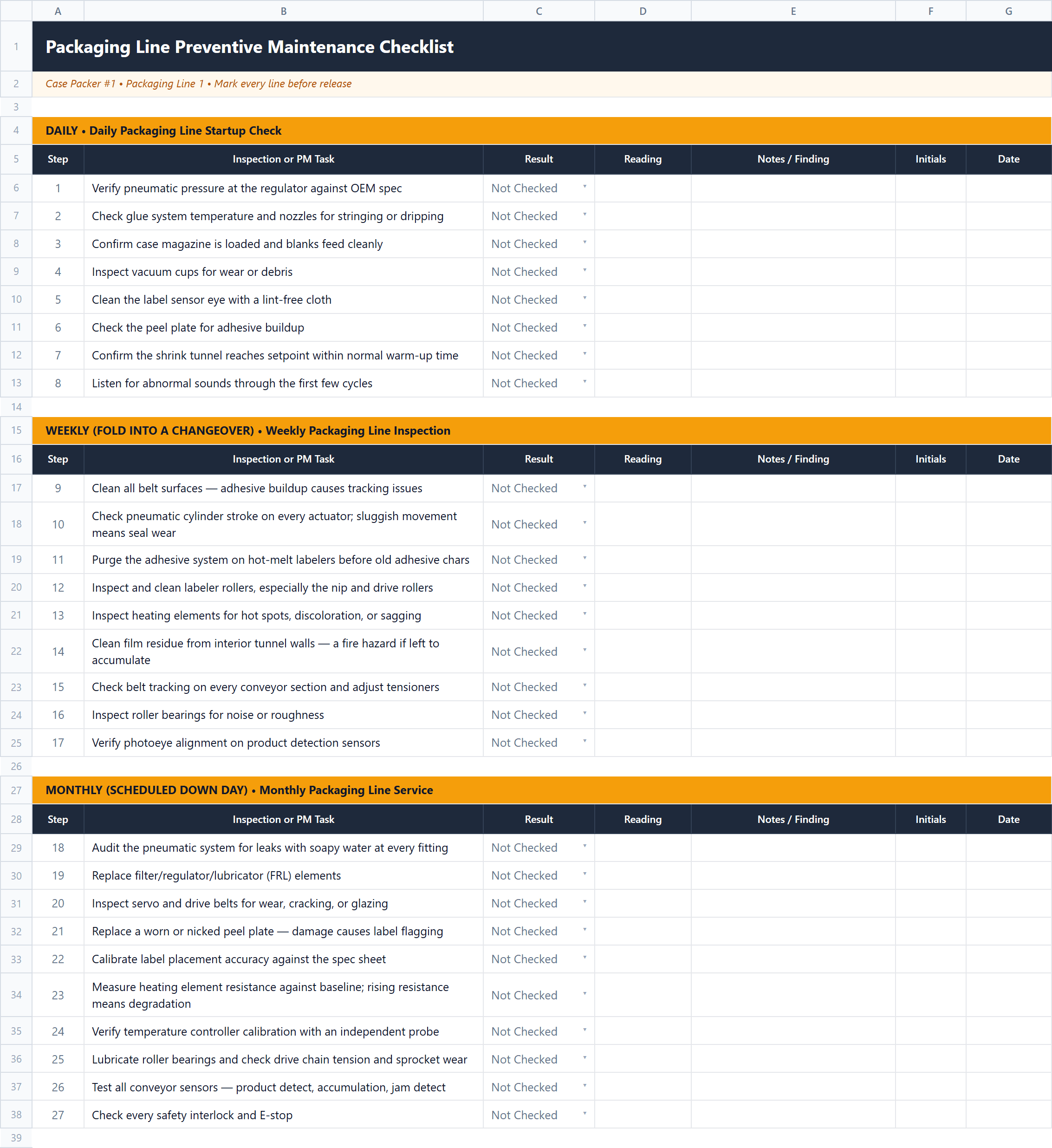
Packaging Line Preventive Maintenance Checklist Excel workbook preview
Actual formatted workbook previewExcel + Google Sheets

Ready-to-use schedule

What's included

Start with these intervals, then adjust them using actual run hours, condition, failures, and manufacturer guidance.

Daily

Daily Packaging Line Startup Check

  • Verify pneumatic pressure at the regulator against OEM spec
  • Check glue system temperature and nozzles for stringing or dripping
  • Confirm case magazine is loaded and blanks feed cleanly
  • Inspect vacuum cups for wear or debris
  • Clean the label sensor eye with a lint-free cloth
  • Check the peel plate for adhesive buildup
  • Confirm the shrink tunnel reaches setpoint within normal warm-up time
  • Listen for abnormal sounds through the first few cycles

Weekly (fold into a changeover)

Weekly Packaging Line Inspection

  • Clean all belt surfaces — adhesive buildup causes tracking issues
  • Check pneumatic cylinder stroke on every actuator; sluggish movement means seal wear
  • Purge the adhesive system on hot-melt labelers before old adhesive chars
  • Inspect and clean labeler rollers, especially the nip and drive rollers
  • Inspect heating elements for hot spots, discoloration, or sagging
  • Clean film residue from interior tunnel walls — a fire hazard if left to accumulate
  • Check belt tracking on every conveyor section and adjust tensioners
  • Inspect roller bearings for noise or roughness
  • Verify photoeye alignment on product detection sensors

Monthly (scheduled down day)

Monthly Packaging Line Service

  • Audit the pneumatic system for leaks with soapy water at every fitting
  • Replace filter/regulator/lubricator (FRL) elements
  • Inspect servo and drive belts for wear, cracking, or glazing
  • Replace a worn or nicked peel plate — damage causes label flagging
  • Calibrate label placement accuracy against the spec sheet
  • Measure heating element resistance against baseline; rising resistance means degradation
  • Verify temperature controller calibration with an independent probe
  • Lubricate roller bearings and check drive chain tension and sprocket wear
  • Test all conveyor sensors — product detect, accumulation, jam detect
  • Check every safety interlock and E-stop

Schedule around changeovers, not around the calendar

Packaging equipment does not fail the way a CNC machine or a hydraulic press does. It fails from changeover damage and product buildup, so inspection frequency should track how often the line changes over — not just elapsed days.

Operator dailies belong in the first ten minutes of the shift, before the line starts. Weekly PMs belong inside a changeover you are already stopping for; the line is down either way. Monthly work belongs on a scheduled down day.

Watch for trends rather than single readings: rising motor amperage means increasing friction, rising element resistance means a heater is on its way out, and a bearing that growls this week seizes next month.

Isolate electrical power, relieve stored pneumatic pressure, and follow your lockout procedure before opening guarding or servicing any pressure-containing component.

Frequently asked questions

How often should packaging line PMs actually run?

Tie them to changeovers rather than the calendar. A line running four changeovers a week accumulates wear far faster than one running a single long campaign, even though the calendar looks identical.

Which packaging asset should get attention first?

The case packer is usually the line bottleneck, so it sets throughput. Conveyors are the most overlooked — they are simple enough to ignore until a bearing seizes and stops everything downstream.

Why does the label sensor need daily cleaning?

Adhesive residue on the sensor eye is the single most common cause of missed labels, and it builds up gradually enough that nobody notices until reject rates climb.

Make the checklist run itself

Add it to RunTight, assign it to equipment, and automatically send each occurrence to the right phone. The Free plan supports up to 25 users—no credit card or per-user fee.

Use this template free